top of page
The sasquatch is a large, hairy, bipedal non-human primate (Fig. 1) that is distributed over the North American continent to varying degrees of concentration. Its massiveness, deviation from human bearing and different gait leave no doubt in the mind of observers that they have seen a creature different from man or known animals.
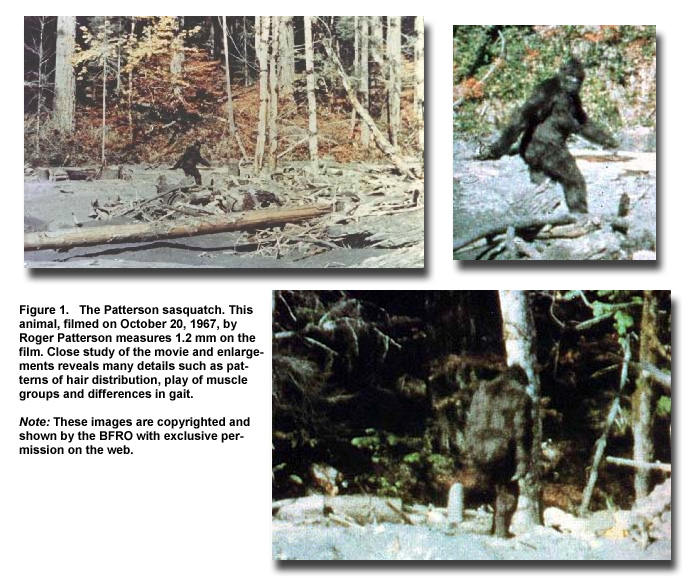
Skin
Skin color ranges from the deepest black or charcoal to deep brown, sunburned reddish brown, and gray. Some areas, like the nose, appear at times in a shiny, oily black color. The palms are lighter in color, and the soles of the feet quite light, presumably as a result of thick sole pads composed, as in other primates, of fat and connective tissue. A few albinistic sasquatches have been seen, whose skin color was pink.
Hair
The sasquatch is covered with hair, not fur. Fur has guard hairs and an undercoat, while primate hair consists of one type of hair alone. The sasquatch, being a primate, does not molt its hair, but it is replaced one hair at a time, hence is not found in wooly batches.
Color of the hair ranges from black or dark (50%), through various shades of reddish-brown and gray to white. Older animals have increasingly grey hair, though color does not appear to change from childhood to adulthood. Hair is variously glossy clean and shiny, fluffy, or dirty, matted and unkempt, probably a function of native curliness, age, or of recent immersion in water or lack thereof.
Hair length ranges from 3" to around 2’. There is no taper or color banding other than graying with age. Long hair covers the head and, almost invariably, the ears; very short hair on the face; occasional reports of heavy hairiness in male faces vs. no facial hair in females; long hair across the top of the shoulders; long hair on the forearms; different orientations of hair on back; breasts in females hair covered; long hair on buttocks, sometimes overhanging them; groin with enough hair to obscure genitalia; and long hair on the calves. The hair stood visibly on end in situations where the sasquatch appeared frightened.
Under the microscope (Fig. 2), the average diameter of hair is 65 µm (40-90 µm), these values derived from 15 separately collected samples in four States. The cortex has a uniform reddish tinge plus fine pigment granule distribution, whereas the medulla is absent. Intense efforts at DNA analysis of the hair have been uniformly negative. Most human hair (Fig. 3) has a medulla, if only fragmentary, but fine blond hair occasionally looks similar to sasquatch hair.
Odor
About 10-15% of close encounters are connected with an intense, disagreeable stench. Gorillas under conditions of distress exude a gagging, overpowering aroma, the origin of which is the axillary organ. The same anatomy probably pertains to the sasquatch.
Head and Neck
The head, though massive by direct comparison to that of man, has been described as "relatively" small for an animal of that size, indicative of a rather small brain. The head develops a sagittal crest in adult males as well as in females, probably bony, which sometimes produces the effect of a person wearing a hooded sweatshirt. Brain volume is probably close to or slightly above that of the gorilla.
There is a conspicuous brow ridge with a receding forehead, giving the eyes a deep-set look. The face (Fig. 4) is rather flat with prominent cheekbones, a square jaw, and the mouth region is only slightly protuberant. Deep brown eye color predominates, with a "red" component common (probably a bloodshot sclera).
The nose is near human in shape, though "pug" or flat, sometimes with forward directed nostrils. The mouth is often reported to be thin-lipped, with yellowish, square teeth with human appearance. Ears are almost invariably hidden under hair and have been reported to be either rounded or pointed.
Trunk
The trunk is generally carried at a forward angle of about 15° ("hunched over"). This means that the species has not achieved a full upright stance, a difference from human beings, although at times the animals stand up straight. The shoulders are proportionately wider than those of man, measuring about 40% of the height in a sasquatch compared to 25-30% in man. Large sasquatches have been described as having four to five foot wide shoulders.
Legs and Feet
The legs are massive, especially the thighs, in one case reported to be the diameter of a "garbage can", but even in the Patterson sasquatch about 15" thick. The calves are also unusually muscular. Feet are most amply recorded by way of innumerable measured footprints. They range in recorded length from 4"-5" (Fig. 7) to known female prints and very large presumptive male footprints (Fig. 8). The mean length of 702 prints is 15.6" (Fig. 9).
Body Size and Weight
The height average for the sampled population is 7’ 10". The animals reach maturity at a height of 6’-7’ and the largest, reliably estimated individuals exceed 10’. Males are taller than females, but seemingly by no more than about a foot at the median of the population.
Weight is estimated to be 650 lbs on average (Fig. 12), the Patterson sasquatch 540 lbs, and the maximum probably to exceed 1,000 lbs.
bottom of page